
February 17, 2026: Theatre Yesterday and Today, by Ron Fassler.
High Spirits, the musical version of Noël Coward’s 1941 international comedy hit Blithe Spirit, arrived on Broadway in the spring of 1964, the 17th of 18 musicals to open that season (to make you weep, this current season will probably wind up with no more than six). Producers had their hands full vying for the attention of committed theatregoers then, the majority of which consisted of New York City’s five boroughs and those coming in from the tri-state area. The blatant catering to tourists in the 21st century—now the bread and butter of most shows—was almost nil back in 1964. By then, television had firmly taken over as a cheaper form of entertainment and pretty much marked the end to an era of sophistication in the theatre, predominantly aiming for the highest common denominator rather than the lowest. It’s important to note that Hello, Dolly!, which opened in January and was the season’s biggest hit, was followed later in the year by Fiddler on the Roof, considered by many when the curtain came down on what is now lovingly called Broadway’s Golden Age.
This is brought up to allow context about what made attending High Spirits so invigorating this weekend, the first musical of the 32nd season of Encores! at City Center. It’s a bold and welcome return to the company’s original mission statement of presenting concert-style productions of older, perhaps forgotten Broadway musicals, with an emphasis on the music, budgeting a large orchestra that is often expanded beyond the numbers in the pit from original productions. The chance to see such shows led by top-tier talent, only previously heard on old cast albums, is mother’s milk to musical theatre aficionados. Here with actors at music stands—even reading aloud stage directions on occasion—is how things were originally staged before a decision to turn Encores! into something like glorified summer stock took over many years back. Having kicked things off in 1994 with the Tony winning Best Musical Fiorello! as their inaugural production, things got really interesting once they hit on major scores from minor shows; especially problematic ones like House of Flowers, Pipe Dream, and Anyone Can Whistle.
By the early 1960s when the decision was made to musicalize Blithe Spirit, Noël Coward was considered out of fashion both in America and his native England. The man who had passionately ignited the theatre world with The Vortex — which he wrote and starred in the West End in the early 1920s — was now considered old hat. If it weren’t for resurrecting himself in 1955 as a Las Vegas crooner of his own songs to keep himself in the spotlight, he dared running the risk of being forgotten. Directing High Spirits turned out to have been his last time doing so on Broadway, and he was actually replaced by Gower Champion during its out of town tryout. Oddly, he didn’t take credit for its book, even though it mostly consists of a good deal of cutting and pasting from his play by the show’s composers and lyricists, Hugh Martin and Timothy Gray.
Both Blithe Spirit and High Spirits tell the story of mystery writer Charles Condomine and his second wife Ruth who, by holding a séance at their home, inadvertently conjures up Charles’s first wife Elvira, dead for seven years. With only slight changes in the plotting and a whole new ending, the major differences were in finding ways to squeeze in a chorus (not successfully as it turned out) and to elevate the supporting character of Madame Arcati to star status, the self-described “happy medium,” responsible for Elvira’s resurrection. Why expand the part? Because Beatrice Lillie was signed to play it, that’s why.

Having triumphed mainly in revues over the course of her career, it was cause for celebration that Lillie would be starring in a book musical solely crafted for her unique talents. This real-life return was not unlike Dolly Levi’s fictional one at the Harmonia Gardens, though in their head-to-head Tony competition Carol Channing was the victor (with the possibility that Barbra Streisand as Fanny Brice conceivably finished third in the voting). Lillie’s reviews were love letters with bouquets thrown by such critics as Walter Kerr, who devoted the first ten paragraphs of his review in the Herald Tribune to her. Ten paragraphs! Normal Nadel in the New York World Telegraph wrote: “Beatrice Lillie’s performance reaffirms her place in the recorded history of the 20th century, along with the Battle of Jutland and the Salk vaccine.”
In terms of inventing singular bits of business, Lillie was considered by many to have been in the same class as Charlie Chaplin. Perhaps this description from Gerald Boardman’s American Musical Theatre: A Chronicle presents some idea of the sort of stunts she pulled in High Spirits:
“But the supreme moment of the evening was a series of curtain calls [Lillie] took early in the second act after a song called ‘Talking to You.’ Every parting of the curtains revealed her in another of the positions assumed by great stars in answer to applause, an uproarious mockery of curtsies and bravura gestures.”
And George Oppenheimer’s review in Newsday makes you yearn for even a few seconds of Lillie’s performance to have been preserved for future generations:
“Martin and Gray have limned her love in an hilarious song that ends with a strip tease behind a screen over which Miss Lillie tosses all her clothes, only to emerge clothed as before.”

Also starring in the original production were Tammy Grimes, Edward Woodward, and Louise Troy. By 1964, Grimes had established herself as a vibrant and unique talent in both plays and musicals (she won a Tony for her starring role as The Unsinkable Molly Brown, even if due to archaic regulations she won it in the Featured Actress in a Musical category). She had starred with Woodward in the previous season’s Rattle of a Simple Man, by Charles Dyer and, in 1958, had played the title role in Coward’s Look after Lulu (1959), which he had based upon a Georges Feydeau farce Occupe-toi d’Amelie. As Charles Condomine, the British Woodward would later make a name for himself as the star of the hit international Australian film Breaker Morant(1980) and the television series The Equalizer (1985–89). As Ruth, Louise Troy graduated from the choruses of Pipe Dream and Tovarich to co-star in High Spirits and received a Tony nomination for Featured Actress in a Musical. She’s marvelous a few years later on the original cast recording of James Van Heusen and Sammy Cahn’s Walking Happy (1966), which also garnered her a Tony nom.
Those who have treasured the original cast recording of High Spirits have forever praised its overture. In Steven Suskin’s invaluable book The Sound of Broadway Music, Hugh Martin tells the story of how it came to be under pressure:
“Don Walker called out at the last minute [apparently because the dates conflicted with that season’s Anyone Can Whistle], and everybody was busy. We ended up with Harry Zimmerman. The orchestrations weren’t very exciting, just ordinary . . . We had a very tame Overture, which sort of put people to sleep. Noël came to me and said, ‘Can’t you goose up the Overture a bit?’ We got Luther Henderson, who did the new Overture. It is terrific. I wish he had done the whole show.”
Here’s that overture, well worth the listen, though it must be said that Mary-Mitchell Campbell conducting the 29-piece Encores! orchestra did a masterful job:
Encores! would undoubtedly make more than a few people happy if they announced other titles from that 1963–64 season like Ervin Drake’s What Makes Sammy Run? (score by Ervin Drake), Foxy (Johnny Mercer and Robert Emmett Dolan), and even a bomb like Hot Spot (Mary Rodgers and Martin Charnin with uncredited contributions from Stephen Sondheim). Personally, I would rather get the chance to hear scores from among that trio (two of which went unrecorded) than another La Cage Aux Folles which is being presented by Encores! in June, which has had two Broadway revivals already.
For High Spirits, dressing up the always reliable Campbell Scott to act as a Noël Coward-type narrator seated on a stool stage left was a nice idea, as was his doubling in the supporting part of Dr. Bradman (his wife, Violet, nicely played by Jennifer Sánchez). As directed with just the right touch of flair by Jessica Stone, it made for a relaxed time of it all. It’s uncertain to me what contributions were made by playwright Billy Rosenfield, credited with “concert adaptation,” but it flowed nicely. In that it’s not all that great a show, overloading with props and scenery might have made things more pretentious as well as counterproductive. But as a musical it has its moments with some witty and tuneful songs and it is a field day for actors, with Rachel Dratch proving just that in the small but funny role of the Condomine’s maid, Edith.

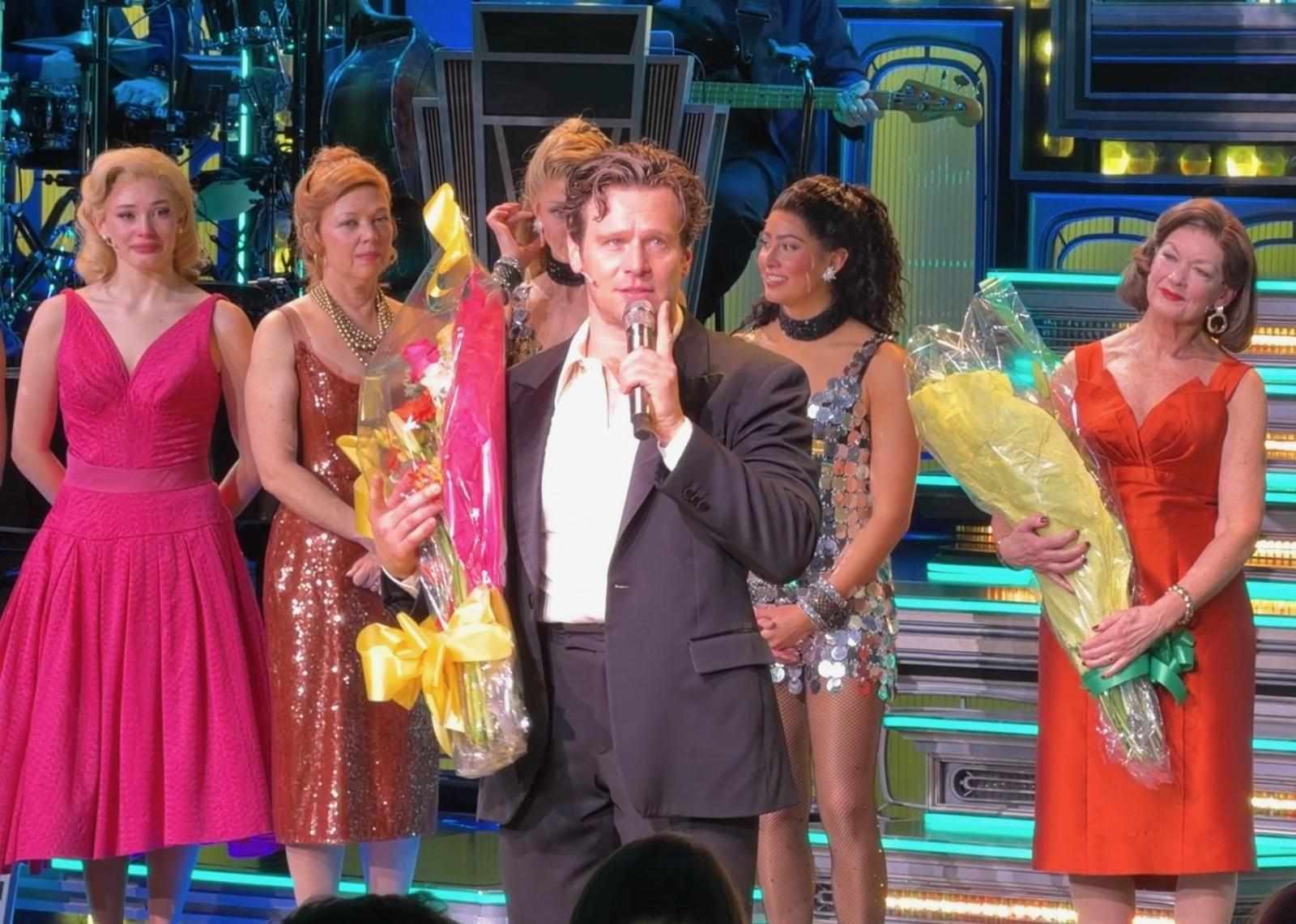
As Charles, Steven Pasquale may lack the clipped Britishness that doesn’t seem to come naturally to him, but when he sings all is forgiven. That he’s playing opposite his wife, Phillipa Soo, is also a plus, for she totally steals Act One (it’s a shame that in Act Two, Ruth’s role is mostly relegated to offstage). Soo not only has a facility with the crisp language, but her comic abilities are used to great effect here. Having seen the couple play opposite one another as Sky and Sarah in Guys and Dolls at the Kennedy Center (2022), one hopes they’ll continue to find vehicles to do together.
As Elvira, Katrina Lenk really hits her stride again. Blown away by her Tony-winning performance in The Band’s Visit (2017), it was bracing to see how Elvira elegantly suits the weirdness that makes Lenk such a captivating presence. It decidedly worked against her as Bobbie, in the gender-twisted revival of Company (2021). The task of trying to recreate what made Bea Lillie such a sensation has fallen to Andrea Martin, one of our greatest clowns. At seventy-nine (!), Martin is certainly game and uses her limber body beautifully (remember her hanging from a trapeze in Pippin thirteen years ago?). However, she is severely limited to what she can do with script in hand so perhaps in a full production and with more rehearsal time, her endlessly inventive comic creativity could have been used to greater effect.

That said, there won’t be a full production of High Spirits brought back anytime soon. It’s simply not good enough to warrant the financing and, with woefully outdated 60s references that, for example, mention the Peace Corps and Cinerama, even if it is a part of its charm, just won’t cut it anymore. After all, the chorus consists of beatniks, if that gives any idea of how truly dated things get.
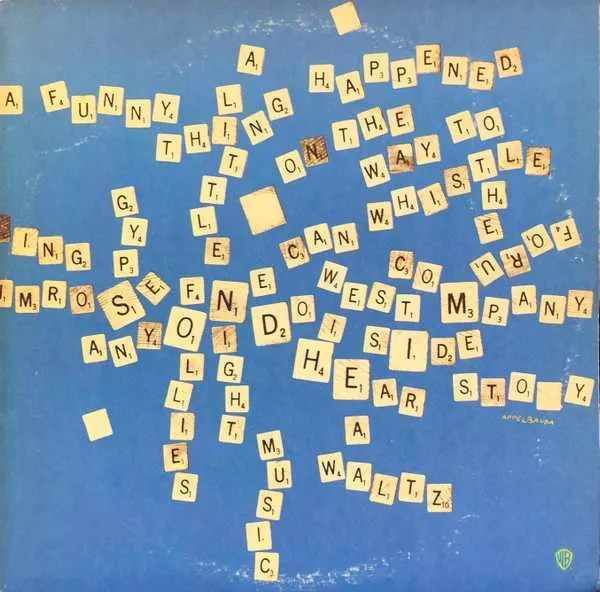
In the end, High Spirits is a minor musical that lacks the force of its source, Coward’s wonderful Blithe Spirit. However, I still applaud those who fought for it to be presented by Encores! as it’s been on a lot of wish lists for three decades among so many musical theatre fans. It was heaven to finally connect with a musical that I only knew from its gatefold album, which I loved poring over as a kid and that I’ve been enjoying listening to for sixty-two years.
High Spirits was presented by Encores! at City Center, 131 W 55th Street, NYC. Click here for information about the next two productions, The Wild Party and La Cage Aux Folles.
Ron Fassler is the author of The Show Goes On: Broadway Hirings, Firings and Replacements. For news and “Theatre Yesterday and Today”columns when they break, please subscribe.


Write a comment ...