
July 4, 2026: Theatre Yesterday and Today, by Ron Fassler.
I've written extensively in these columns over the past ten years about the musical 1776 due to it being one of my tip-top favorite shows and look forward to when July 4th rolls around as at gives me an excuse to extol its virtues. This year, due to our current political tensions, the occasion of the 250th anniversary of the signing of the Declaration of Independence doesn't feel very joyous. Celebrating seems hollow when we're in the midst of our storied democracy being corrupted by a tyrant. In 1776, King George III plays the tyrant even though he doesn't appear onstage like he does in Hamilton. What both shows highlight is just how revolutionary the Revolutionary War was; how our Founding Fathers risked their lives to create these United States. As Peter Stone, 1776's book writer, has Ben Franklin say: "We've spawned a new race here—rougher, simpler, more violent, more enterprising, and less refined. We're a new nationality . . . we require a new nation."
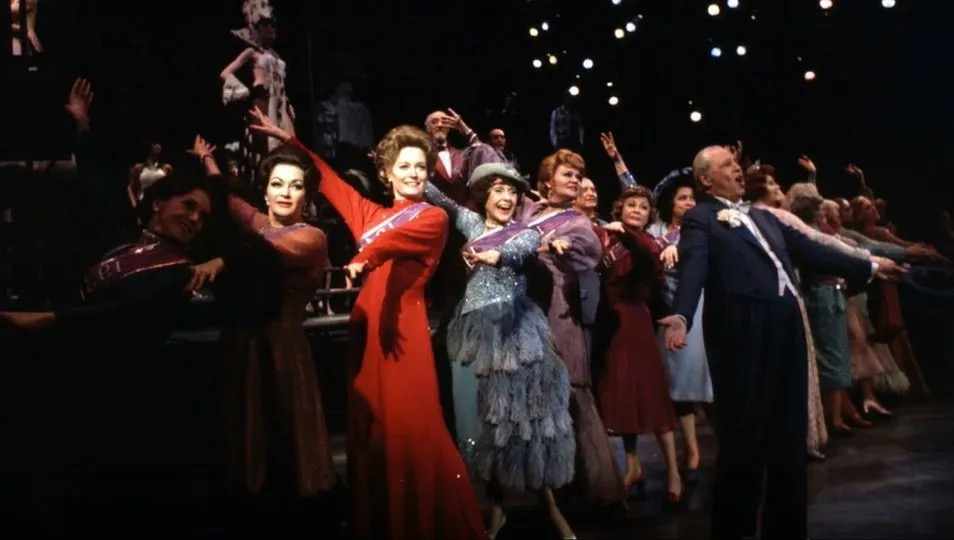
When 1776 opened on March 16, 1969, the Vietnam War was raging, and protests were at a fevered pitch. The timing couldn't have been worse for a flag-waving, patriotic musical. In fact, William Daniels, who gave a career-defining performance both onstage and on screen as John Adams, mistook the play as propaganda and didn't want to do it. It was his wife, the actress Bonnie Bartlett, who talked him into it. 1776 was indeed a serious effort, utilizing the musical form as an unlikely vehicle to examine the compromises that had to be made to create the United States. The cobbling together of fifty-six Congressman from New Hampshire to Georgia, representing the thirteen colonies, to think together as one. Of course, that number isn’t a practical one for the stage and the shrinking down of characters (20 Congressman are depicted) and the combining of certain individuals makes for leaner and cleaner drama. John Adams, its leading role, is a composite of our nation's future second President and his cousin, Samuel Adams, also a Massachusetts representative to the Continental Congress. Having two of them onstage would have been confusing and a grave mistake.

It could have been ludicrous to have a singing and dancing John Adams, Thomas Jefferson, and Benjamin Franklin. Four years earlier, a musical titled Ben Franklin in Paris couldn't make it work, closing after a disappointing six-month run despite a superstar like Robert Preston as wily old Ben. With its roots in operetta which, by 1965, was nearly an extinct species, Ben Franklin in Paris was practically DOA. In contrast, the score that Sherman Edwards wrote for 1776 boasts an elegance and whimsicality that made it right for the moment. Edwards, a pop songwriter, had big hits with "Wonderful! Wonderful!" for Johnny Mathis and "See You in September," which rose to #3 on the Billboard Hot 100. Prior to his theater career, a passion for American history was something he passed on to his high school students as a social studies teacher. Initially, he wrote the book, music and lyrics for 1776, but when Stuart Ostrow agreed to produce it, he insisted that Edwards needed help in shaping the story into something more cohesive.
Enter Peter Stone. At this stage in his career, Stone had already won an Emmy as part of the writing team on TV's The Defenders, an Edgar Allan Poe Award (Mystery Writers of America) for 1963's Charade, starring Cary Grant and Audrey Hepburn, and an Academy Award for Best Original Screenplay for Father Goose (1964), starring Cary Grant and Leslie Caron. He also found the time to write the books for two Broadway musicals, Kean (1961), and Skyscraper (1965), neither of which was particularly distinguished, but give the man his due for being prolific. He certainly hit his stride with 1776, which earned him a Tony Award with two more to come for his librettos to Woman of the Year (1981) and Titanic (1997). 1776, his crowning achievement, is one of those books that might even stand on its own without music, much like the one Arthur Laurents wrote for Gypsy.

One scene in 1776 stands out. It's early in the play and serves to introduce the Congress man by man as well as launch into the crux of its drama: the vote on breaking off from England and declaring America its own independent country. Time and again, Stone puts words into Benjamin Franklin's mouth that you would swear are actual quotes, when none of them are. The that way Stone channels Franklin's voice is uncanny, as this example shows:
Dickinson: What's so terrible about being called an Englishman? The English don't seem to mind.
Franklin: Nor would I, were I given the full rights of an Englishman. But to call me one without those rights is like calling an ox a bull—he's thankful for the honor but he'd much rather have restored what's rightfully his.
This dialogue is from a scene early on that goes on for twenty-five minutes without a song, the longest by far of any musical that’s come before or since. When Peter Hunt, the show's twenty-nine-year-old director was confronted with this sequence, he tried like hell to pare it down, but it covered so many important plot points it couldn't be done without leaving the audience clueless to the proceedings. As Hunt once told me, he called his old Yale classmate Richard Maltby Jr. in desperation and asked, "Has there ever been a sequence in a musical where there are no songs for nearly a half-hour?" Maltby responded, "No, and you can't do that." Hunt said, "That's all I needed to hear," slammed down the phone, did it anyway and, in the process, made history.

1776 came to town in the winter of 1969 after an out-of-town run in New Haven that was fraught with difficulties. Its next stop in Washington D.C. went much better with an ending added that made all the difference in the world; one that even impressed Stephen Sondheim. When I interviewed him for my book Up in the Cheap Seats, I asked him what he thought of the show and he only wanted to talk about the finish:
“Stuart Ostrow asked me to come down to Washington to see it. And I did. And I thought it was okay until the final moment. The final three or four moments, three or four minutes, when my hair stood on end and I started to cheer when the curtain came down. And that ending is all the arranger’s ending. The dissonant music is what made it. And that was not Sherman [Edwards]. That was, I think, Eddie Sauter’s ending.
And what Eddie Sauter did is one of the greatest things I ever saw.”
If you've never seen the show or its ending, it's duplicated in the 1972 film version, which airs on the 4th Turner Classic Movies as it does every year. For the entire story of how the ending came about, as told to me by Peter Hunt, you can find it here.
And talk about stakes! During the debate on independence, Franklin shouts down one naysayer with this line:
"You act as if this is a new idea. It's never been done before. No country has broken off from its parent stem in the history of the world.”

Stone never lets the story veer off into tangents, keeping front and center the pounding heart of freedom its central notion. Again, Franklin:
"And besides, what will posterity think we were—demigods? We're men—no more, no less—trying to get a new nation started against greater odds than a more generous God would have allowed."
Like Lin-Manuel Miranda says in Hamilton: “Who lives, who dies, who tells your story.”
Ron Fassler is the author of The Show Goes On: Broadway Hirings, Firings and Replacements. For news and “Theatre Yesterday and Today" columns when they break, please subscribe.


Write a comment ...