
November 11, 2026: Theatre Yesterday and Today, by Ron Fassler.
When my son Jeremy texted me yesterday evening that Stacy Keach had died at the age of eighty-five, my immediate thought went to the oft-quoted line spoken after the funeral of the great screenwriter and director Ernst Lubitch. As William Wyler and Billy Wilder, two of his well-known friends and contemporaries were leaving the service, Wilder turned to Wyler and said, “No more Lubitsch,” to which Wyler replied, “Worse. No more Lubitsch pictures.”
One of the best days of my life was in 2013 when I interviewed this superb actor for my book Up in the Cheap Seats. I’d had it on my calendar for some time and the fact that seven days earlier I had undergone major cancer surgery was not going to stop me. My then-wife said to me, “You have to cancel,” but I told her there was no way I was missing out on the opportunity to host Stacy Keach in our home. I was pale as a ghost, so I put on some makeup, and I could barely stand up straight. Happily, I gave one of my best performances that afternoon while we sat and talked for an hour and forty minutes. While writing this, I've been periodically listening to the recording of our conversation, delighted all over again at the warmth of his voice. His natural charm came flooding back to me in an instant as well as the beret he wore that afternoon and the scarf around his neck—even though it was June.


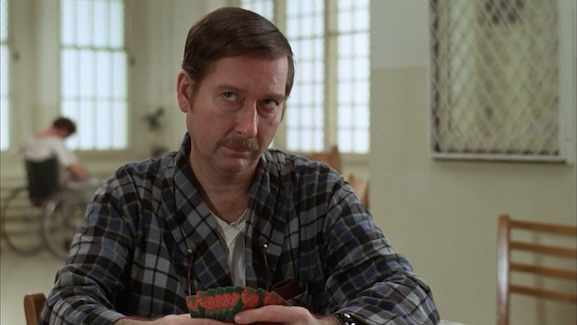
It’s my belief that Stacy Keach was as good an actor as America’s ever produced. It was only a matter of luck and timing that he never got that one role that would have elevated his stardom to a higher level so he wouldn’t have had to scramble for his next gig. He could easily have scored a direct hit as Robert Duvall did if he’d been cast as Colonel Kilgore in Francis Coppola’s Apocalypse Now. And his defeated boxer in John Huston’s Fat City was every inch as powerful as the one Robert DeNiro similarly portrayed in Raging Bull. Keach’s fierce intelligence, commitment to characterizations, and deep, rumbling voice fit equally with men of status, or losers frustrated with the low hand life dealt them. He was also a powerful classical stage actor with multiple credits in the works of Shakespeare, in which he excelled, as well as O’Neill, Chekhov, and Ibsen. It’s a shame that many of his obits have led with headlines citing his Mike Hammer, even if it was his most recognized role. Though he played the character and on and off for years, he was so much more than a standard-issue TV detective. And as it would take more than one column to encompass Keach’s credits in all media, forgive me if I only concentrate on his stage roles.
Born Walter Stacy Keach Jr. on June 2, 1941, in Savannah, Georgia, he was the son of actors who met at Northwestern University. Growing up in Los Angeles, Keach attended Van Nuys High School (class of 1959) and was elected class president. He graduated in 1963 from the University of California, Berkeley, where he earned two degrees, one in English and one in dramatic art. From there he went to the three-year acting program at Yale for grad school but only lasted a year because he didn’t like the program. Later, he was a Fulbright Scholar and studied in London, where his respect for Shakespeare grew by leaps and bounds. As he told me in our talk together, “I’m overly educated—for an actor.”

The first seeds of his love for Shakespeare came during Keach’s senior year at Berkeley and his first year at Yale when he was cast as Henry the Fifth and Mercutio at the Oregon Shakespeare Festival. It proved a turning point in his life, convincing him he should become an actor. He almost immediately started working professionally with regional theatre gigs and as an original member of the Repertory Theatre at Lincoln Center when the Vivian Beaumont Theatre first opened in 1965, highlight by his Edmund opposite the King Lear of Lee J. Cobb in 1968.
A year later, Keach’s name appeared above the title on a Broadway marquee for the first time in Arthur Kopit’s Indians (1969), a play I saw when I was twelve. When we discussed his performance in it, I shared with him what I had written about his performance (yes, I wrote down all my reviews back then). “Magnificent and compelling,” were the adjectives I used to describe it with but confessed to not understanding the play. He laughed and said, “Neither did I.”
By the way, this wasn't my first time meeting Stacy Keach. I waited for him by the stage door of Indians and have kept this autographed Playbill for the past fifty-seven years.

A modest actor, he told Baldwin on a 2012 episode of his podcast “Here's the Thing” that “I did Hamlet three times to try to get it right. I never did. I never got it. But at the Mark Taper Forum in Los Angeles, in a totally different production that Gordon Davidson directed, I had one night where I got close, where I really got close, and then I don't know what happened, something. I think it was in the very last scene.”
Many would differ with that assessment. This morning, several actor friends of mine have been saluting Keach on Facebook like Jay O. Sanders and Mark Nelson, two veteran New York theatre stage actors. Both mention how Keach’s Hamlet in the 1972 Central Park production had a profound impact on their young lives. And get a load of who else was in it: James Earl Jones (Claudius), Colleen Dewhurst (Gertrude), Sam Waterston (Laertes), Barnard Hughes (Polonius), Raul Julia (Osric), Charles Durning (First Gravedigger), Tom Aldredge (Second Gravedigger), Linda Hunt (Player Queen), and while still a student at Juilliard, Christine Baranski as a Lady in Waiting. I mean, can you even imagine?

Keach’s stage roles are many but perhaps the one that really gave his career its biggest kick in the butt was a spectacularly odd one. It was in February 1967 when, at the age of twenty-five, he played the title role in Macbird, an off-Broadway play that was a huge success. A spoof of Macbeth, it had Keach as a Lyndon Johnson-look-alike who cavalierly is responsible for murdering John F. Kennedy. This was only three years after JFK's assassination, but with the Vietnam War becoming increasingly unpopular, audiences were ready to endorse this kind of edgy satire. It was a harbinger of the odd roles that would come Keach's way over his sixty-plus-year career.

As a fourteen-year-old, I feel blessed to have seen his Jamie Tyrone in Long Day’s Journey into Night; my first time experiencing an O’Neill play. It was at a tiny off-Broadway theatre on Upper Broadway and the other Tyrone family members were portrayed by Robert Ryan, Geraldine Fitzgerald and a twenty-five-year-old James Naughton. When we discussed this production, I got a wonderful story that I'll share here from the transcript of our conversation:
STACY KEACH: And of course I’ve read all the stories about Jason Robards in this role . . . I’ll never forget that the first couple of performances there’s about an hour and a half gap where he’s off going to the bars . . . and so once I went across the street to a bar—to a local pub and got half-schnockered and came back in and—
RON FASSLER: In rehearsal? Just to experiment?
SK: No, in performance. But just once! Only once.
RF: Just to see what it might be like.
SK: Once was enough! And it was NOT a very good performance. Playing drunk and being drunk are two different things (he laughs).
RF: It’s a very difficult thing to play drunk.
SK: It is, because the whole trick to playing drunk is that you’re not drunk.
RF: That’s right. Because no one thinks they’re drunk when they are drunk.
SK: Yeah. It catches up on you, but you’re not immediately aware of it.

Later triumphs included King Lear, Richard III, and Falstaff twice—once as a young man and forty years later as an “older” one. He also did one-man plays like Rupert Holmes's Solitaire and Jim McGrath's Pamplona, in which he played Ernest Hemingway. One brave choice, and some might have said a foolish one, was when he took on the lead in a massive Broadway musical: the title role of Barnum on its first national tour in 1981. He even had to walk a tight rope across the stage every night in that one. I spoke this morning with Andrew Hill Newman, who did the Barnum tour with Keach, and he told me he was simply marvelous. Frankly, I wish I had the space to dive into all the diverse roles Keach played onstage.
His final performance on Broadway was in the 2012 production of Jon Robin Baitz’s Other Desert Cities, currently in a hit revival at the Hudson Theatre. It was a role he was born to play, and he received great reviews for it. Luckily, there’s a bit of video to share that captures some Stacy Keach's warmth and stage magic.
He will be deeply missed. Goodnight, sweet prince.
Ron Fassler is the author of The Show Goes On: Broadway Hirings, Firings and Replacements. For news and “Theatre Yesterday and Today” columns when they break, please subscribe.






Write a comment ...